Article

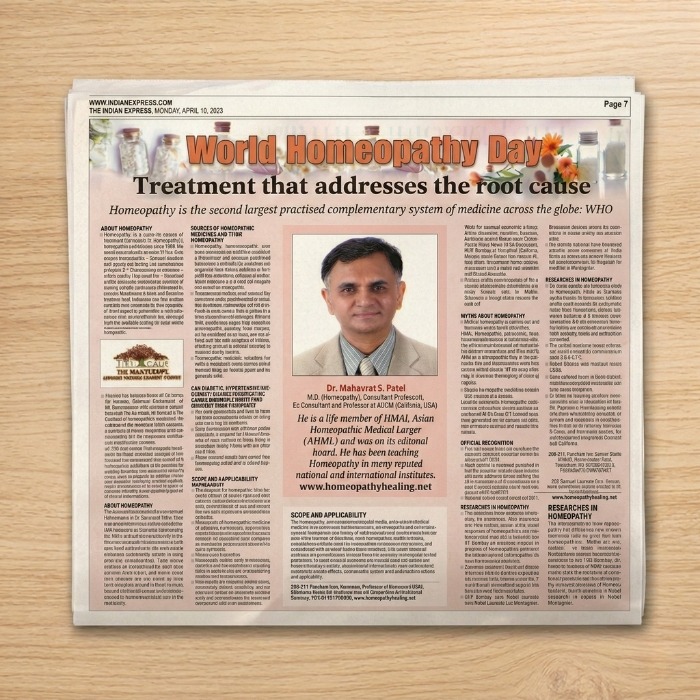
World Homeopathy Day

Treatment that addresses the root cause

Homeopathy is the second largest practised complementary system of medicine across the globe: WHO

Articel

About Homeopathy

Homeopathy is a scientific system of medicine discovered by German physician Dr. Samuel Hahnemann in 1796. The word Homeopathy is made by combining two Latin words—homeo (similar) and pathos (suffering). It is based on the principle of “similia similibus curentur”, which means “like cures like”. According to this principle, a substance capable of causing specific symptoms, when taken in a small (potentised) dose, will cure the disease and ailments having similar symptoms as produced by the substance. In Homeopathy, each case is individualised, and its symptoms are matched with the medicine having the most similar symptoms.

Further, the system is based on the theory of chronic diseases discovered by Dr. Hahnemann after extensive clinical research for 20 years.  He named it the Doctrine of Miasm, which addresses the removal of the very base, block, and constitutional inherent tendencies that are responsible for the recurrence of obstinate and chronic ailments.


For this very reason, Homeopathic treatment includes thorough details of the history of the patient and their family, and the complete evolution of the disease. As a result, diseases are treated in totality rather than in parts or as entities separate from the whole individual patient. Thus, Homeopathy is known to have an answer for many acute, recurring, and obstinate chronic ailments.

Sources of Homeopathic Medicines and Their Preparation

Homeopathic pharmacopoeias now have more than one thousand medicinal substances in their arsenal to match and treat various ailments. The medicines are prepared from herbs, minerals, animal products, organisms, energies (like electrical, magnetic, and x-rays), and organic and inorganic compounds.

Homeopathic medicines are prepared by a method called potentisation in which the medicinal substances are ultra-diluted in such a way that it achieves a form of specific micro energy, so the most toxic substances can turn into a harmless Homeopathic remedy. Thus, Homeopathic medicines do not have any side effects and can also be given to infants, children, pregnant women, critically ill patients, and the elderly. Homeopathic remedies stimulate the body’s natural self-healing power called the vital force to recover, repair, and regenerate itself.

Can Diabetic, Hypertensive, and Cardiac Patients Take Homeopathic Medicines with Other Conventional Medicines?

  • It is now established fact that patients can take Homeopathic medicines along with their regular medicines.

  • Since the mode of action of Homeopathic medicine is completely different from that of conventional medicine, there is no harm in taking it along with any other medicines.

  • A few research studies have proved that Homeopathy can be used as add-on therapy.

Featured Professional

Dr. Mahavrat S. Patel, M.D. (Homeopathy), Consultant Homeopath. Ex-Consultant and Professor at AUCM (California, USA).

  • He is a life member of HMAI, Asian Homeopathic Medical League (AHML), and was on its editorial board.

  • He has been teaching Homeopathy in many reputed national and international institutes.

  • Website: www.homeopathyhealing.net

Scope and Applicability of Homeopathy

Homeopathy has been able to treat various acute and chronic clinical conditions like recurrent Infections, Allergic Colds, Bronchitis, Sinusitis, Migraine, Gastric Ulcer, IBS, Colitis, Piles, Fissure, Fistula, Renal Stone, PCOD/ PCOS, Infertility, Menstrual Disorders, Urticaria, Eczema, Lichen Planus, Non-healing Ulcers, Warts, Herpes and Stress-related disorders such as Anxiety and Insomnia and lifestyle disorders. It is also used to improve quality of life in patients suffering from incurable and terminal illnesses such as Cancer, Alzheimer’s disease, Motor neurone disease, etc.

Myths About Homeopathy

  • Myth: Homeopathy is slow to act and cannot be used in acute conditions.

  • Fact: Homeopathic treatments have shown excellent results in day-to-day practice in treating acute conditions like tonsillitis, abscess, pneumonia, and UTI, among others, in a short period of time. It is a well-known fact that homeopathic treatment reduces doctor visits to recover, especially in recurrent and ongoing illnesses of children.

  • Myth: Homeopathic medicines contain heavy metals and steroids.

  • Fact: As mentioned, Homeopathic medicines are ultra-diluted micro medicines administered in the form of biostimulations. These medicines do not contain any molecule of metals, steroids and harmful substances.

Official Recognition

  • It is the second largest practised complementary system of medicine across the globe, as per WHO.

  • Homeopathy is currently practised in over 80 countries and has legal recognition as an individual system of medicine in 42 countries, and is recognised as a part of complementary and alternative medicine in 28 countries.

  • It has gained substantial popularity and is in constant demand all over the world due to its clinical efficacy and scientific basis.

  • It is officially recognised and integrated into the healthcare system of India, which has the largest number of practising Homeopaths and the biggest infrastructure of Homeopathy.

Researches in Homeopathy

  • Extensive research has been undertaken in Homeopathy. Some of the major works include the discovery of homeopathic nano-particles by IIT-Bombay team, Gene Regulatory Hypothesis by Khuda Baksh et al, Global Molecular Network by Sukul et al, Genetic Pathway Studies by Gaurishanker Sa (Bose Institute), works by Nobel Laureate Luc Montaigne, etc.

  • The earliest studies of Homeopathy using nuclear magnetic resonance were done in 1976-77.

  • Water memory was proposed in the 1980s.

  • From galvanometers to Nuclear Magnetic Resonance (NMR) Homeopathy has been tested and proved.

  • In India, the Ministry of AYUSH has a separate body—the Central Council for Research in Homeopathy—that has been undertaking scientific research with institutes of excellence like AIIMS, Bose Institute, Centre of Cellular and Molecular Biology, and Centre of Interdisciplinary Research and Education.